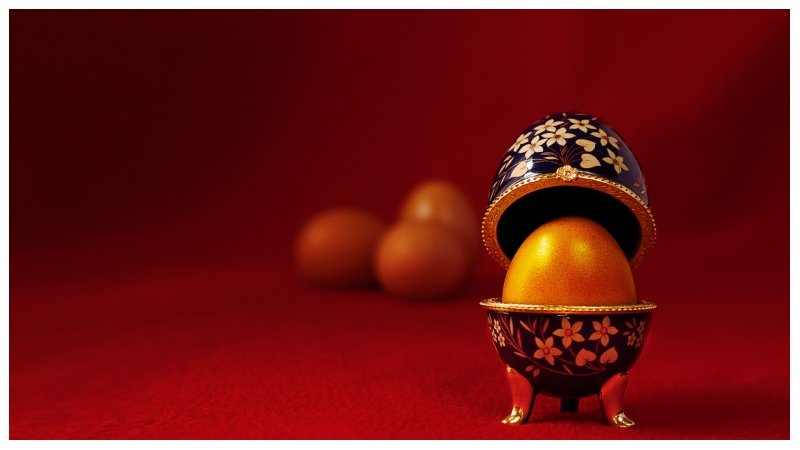
Between 1885 and 1916 the House of Fabergé delivered fifty Easter eggs to the Russian imperial family, each one hiding a small surprise inside. Of those fifty, 43 are known to survive, while the other seven exist only in archive records and, for some of them, in a few old photographs. One of the eggs once thought lost reappeared as recently as 2012, when a scrap metal dealer in the United States found out that the little gold egg he had bought to melt down was the Third Imperial Egg of 1887.
The surviving eggs are now spread across Russia, the United States, Britain and a handful of private collections, and many of them sit in museums that anyone can visit. For a traveller with an interest in decorative art, following them from one city to the next is a good way to retrace a story that begins in the private rooms of the Romanovs and passes through the Soviet sales of the 1920s before reaching the display cases of today.
An Easter present that became a family ritual
The first egg was ordered by Tsar Alexander III as a gift for his wife, Empress Maria Feodorovna. From the outside it looks plain, a shell of white enamel on gold, yet it opens to reveal a gold yolk, then a small gold hen and, inside the hen, a tiny replica of the imperial crown with a ruby pendant, both of which have since been lost. The empress liked it so much that the tsar made the egg an annual commission, leaving the design to Peter Carl Fabergé on the single condition that every piece should contain a surprise.
When Nicholas II succeeded his father in 1894 he kept the custom and doubled it, so that from the following spring two eggs left the workshops almost every Easter, one for his mother and one for his wife, Alexandra Feodorovna, with a pause only in 1904 and 1905, during the war with Japan. The work was entrusted to the firm’s workmasters, the heads of the individual workshops who stamped the pieces with their initials. The best known are Michael Perchin, who led the imperial commissions until his death in 1903, and Henrik Wigström, who took over from him.
The surprises are where the small scale of the work shows best. A hen small enough to sit inside an egg, and a crown smaller still that fitted inside the hen, had to be shaped in gold with the same care as a full-sized piece, and miniature sculpture of this kind is still made today, although many workshops now start it in a different way, carving the form in wax and casting it in metal by the lost wax method that metalworkers have used for thousands of years. Jewellery schools still teach it from the first steps. Among them, the Accademia delle Arti Orafe offers a lost wax jewelry course in Rome that works through every type of jewellery wax, from sheet and soft waxes to the hard blue and green ones that are filed into shape.
Why the colour came from glass
What made these objects recognisable at a glance was enamel, which is glass ground into powder, laid on metal and fused in a kiln until it sets into a hard, bright layer. Each colour usually needs its own firing, and a crack appearing in the last pass can spoil a piece that has taken weeks of work, which is why the craft has always been learnt at the bench, under the eye of someone who has already made those mistakes. The classic ways of holding the glass in place are still taught today: thin wires bent into small cells in cloisonné, hollows cut into the metal in champlevé, and open frames that let the light through like a stained-glass window in plique-à-jour.
Fabergé’s own signature went one step further and is known as guilloché enamel. A machine called a rose engine cut fine, regular lines into the metal, in waves, sunbursts or moiré patterns, and the workshop then covered them with layers of translucent enamel through which the pattern kept showing, so that the surface seemed to ripple as it caught the light. The pale pink of the Colonnade Egg of 1910 and the bright yellow of the Coronation Egg of 1897 are both made this way.
How the eggs left Russia
The two eggs being prepared for Easter 1917 were never delivered, because the February Revolution had forced Nicholas II to abdicate. The Bolsheviks nationalised the firm in 1918, Peter Carl Fabergé left Russia and died in Lausanne two years later, and the imperial treasures were gathered in Moscow. Ten eggs stayed in the Kremlin, while from the late 1920s the Soviet government, short of foreign currency, sold many of the others abroad, often for modest sums, to buyers such as the American businessman Armand Hammer and the London dealers Wartski.
Through those sales the eggs reached British and American collectors. King George V and Queen Mary bought three of them in the 1930s, the American collectors Lillian Thomas Pratt and Marjorie Merriweather Post assembled their own groups, and later the publisher Malcolm Forbes put together nine imperial eggs in New York. That last collection made the journey back, since the nine Forbes eggs returned to Russia in 2004, when the businessman Viktor Vekselberg bought them shortly before they were due to be auctioned.
Where the eggs can be seen today
The largest groups are in Russia. The Fabergé Museum in St Petersburg, which opened in 2013 in the Shuvalov Palace on the Fontanka embankment, shows the nine former Forbes eggs, among them the Hen Egg and the Coronation Egg, and the Kremlin Armoury in Moscow keeps the ten that never left the country. British visitors should bear in mind that the Foreign, Commonwealth and Development Office currently advises against all travel to Russia, so for now these two collections are easier to explore through their catalogues.
Across the Atlantic the trip is simpler. The Virginia Museum of Fine Arts in Richmond displays the five imperial eggs left to it by Lillian Thomas Pratt in 1947, in galleries devoted to her Russian collection, and Hillwood, Marjorie Merriweather Post’s former home in Washington DC, holds two more. The two cities are only about a hundred miles apart, so both visits fit easily into the same trip, and anyone heading towards the Great Lakes can add the Cleveland Museum of Art, which owns one of the two Red Cross eggs of 1915, made while the empress and her elder daughters were working as wartime nurses. The three eggs of the Royal Collection, on the other hand, are not on permanent display and come out from time to time for temporary exhibitions, so it is worth checking the Royal Collection Trust programme well before planning a trip around them.
Frequently Asked Questions (FAQ)
How many Fabergé imperial Easter eggs are still missing?
Seven of the fifty imperial eggs delivered to the Romanovs are still unaccounted for. Some may have been broken up for their gold and stones in the years after the revolution, while others could be sitting unrecognised in private homes, which is exactly what happened to the Third Imperial Egg before it was identified.
Can you see the Fabergé eggs in Richmond and Washington on the same trip?
Yes, since Richmond lies roughly two hours south of Washington by road or rail. The Virginia Museum of Fine Arts in Richmond and Hillwood in Washington DC together hold seven imperial eggs, and since opening days and booking rules change, both websites are worth checking before setting out.
Is every Fabergé egg an imperial Easter egg?
No. Apart from the imperial series, the firm made a small number of large eggs for private clients, such as the seven ordered by the industrialist Alexander Kelch for his wife, and thousands of miniature egg pendants that Russians gave one another at Easter. A piece described as a Fabergé egg in a shop or an auction catalogue is far more likely to belong to this second group. Click here for more Information.