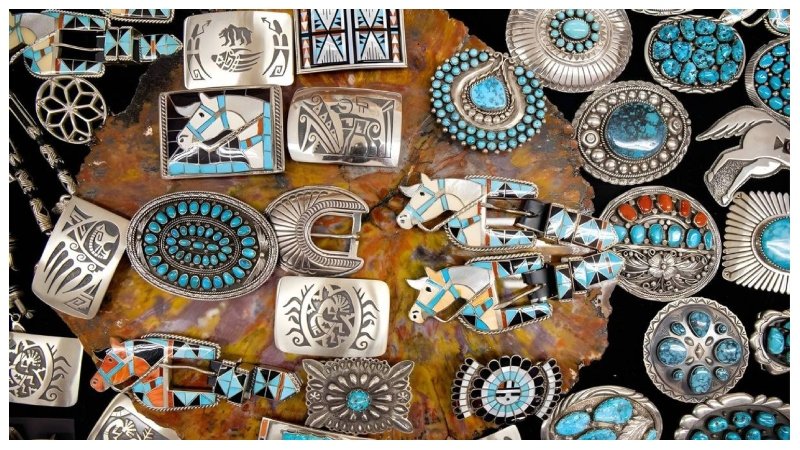
Arizona’s jewelry scene did not emerge from trend cycles or retail strategy. It grew out of the ground, shaped by centuries of mineral wealth, Indigenous craftsmanship, and a population that has always placed real value on tangible things. Understanding what drives this market today means looking at what built it in the first place.
The Mineral Foundation Beneath It All
Few states can claim the geological identity that Arizona carries. The land holds copper, turquoise, gold, silver, and a range of semi-precious stones in concentrations that drew miners, traders, and craftspeople long before Arizona achieved statehood. That abundance did not just fuel an extractive economy. It seeded an aesthetic one.
Arizona produces 71% of the nation’s copper, along with significant amounts of gold, silver, lead, zinc, and precious stones. Copper mining also yields gold and silver as byproducts, which means the same operations that built Arizona’s industrial base also supplied raw material for its jewelry trade. Two industries, one hole in the ground.
Mineral discoveries as far back as 1000 BC show Native Americans using turquoise, copper, coal, and clay, with copper and turquoise traded across North America. That trade network is not ancient history in any abstract sense. It is the direct ancestor of the regional jewelry market that exists in Scottsdale, Tucson, and Phoenix today.
Turquoise and the Indigenous Craft Tradition
No material defines Arizona jewelry more completely than turquoise. Its presence here is not decorative or incidental. It is cultural, spiritual, and tied to the land in ways that predate any modern retail concept.
A Stone With Roots in the Hohokam Culture
Turquoise beads have been found in archaeological sites dating back over 2,300 years in the Hohokam culture, a prehistoric people who inhabited parts of what is now Arizona, making them among the earliest known users of turquoise for jewelry and adornment.
The stone carried meaning well beyond appearance. Across many Native American cultures in Arizona, turquoise is considered spiritually significant. For the Navajo, it represents protection and harmony, often connected to the sky and life-giving rain, while the Apache believe turquoise can enhance aim and guide warriors, standing for strength and good fortune.
Silversmithing and the Navajo Tradition
The pairing of turquoise with silver came later, but it cemented the look most people now associate with Southwestern jewelry. The Navajo and the Zuni, the best-known turquoise jewelers, have distinct styles that remain recognizable today.
The first Native American silversmith, a Navajo, learned to work silver and iron from Mexicans hired by a trading post owner in the late 19th century, and modern jewelers still use many of those early methods. Atsidi Sani taught others of his tribe, and the Navajo soon dominated the silver and turquoise jewelry craft.
Arizona’s Official Gemstone
Arizona was a major turquoise producer for decades. By the 1970s, the state was pulling more than 100,000 pounds of it annually from the ground. In 1974, Arizona officially designated turquoise as its state gemstone, acknowledging both the mining industry’s contribution and the Native heritage that had given the stone its cultural weight for thousands of years. Long overdue recognition, honestly.
How Geography Shaped the Market’s Character
Arizona’s jewelry market is not uniform across the state. The terrain itself determined which communities developed which specialties, and those distinctions still hold.
The southeastern mining towns, Bisbee, Jerome, and Globe, produced raw material and attracted craftspeople who worked close to the source. The Kingman turquoise mine is one of the oldest and largest in the world, worked by Native American tribes for over a thousand years. Mines like Kingman and the Sleeping Beauty mine in Globe produced stones with qualities specific to their geology, and collectors and designers still seek them out by name.
The Phoenix metro, Scottsdale in particular, developed along a different path. Wealth concentration, retiree migration, and tourism created a retail environment oriented toward fine goods and estate pieces. In 2024, the median household income in Scottsdale was $110,886, well above national and state averages. That income profile pulls the market toward quality over volume.
Then there is Tucson. The annual Tucson Gem, Mineral and Fossil Showcase draws over 65,000 visitors from around the world, many of whom buy Arizona’s native gemstones and jewelry. It functions as a concentrated marketplace where serious collectors and dealers transact at meaningful volumes, a kind of annual reckoning for the entire regional trade.
The Resale Layer That Completes the Picture
A mature jewelry market always develops a strong secondary tier. Arizona’s is well-developed. Estate jewelry, vintage Native American pieces, and pre-owned fine goods move through Scottsdale and Phoenix at a pace that reflects both the wealth of incoming residents and the life transitions that follow major relocations.
Families arriving from California, the Midwest, and the Northeast bring collections with them. Downsizing, estate settlements, and shifting tastes push pieces into circulation. For anyone looking to sell old jewelry in this market, Scottsdale offers a buyer base that is knowledgeable, active, and comfortable evaluating quality pieces at fair prices.
Authentic Native American jewelry, especially vintage Navajo and Zuni pieces, ranks among the top sellers at Scottsdale and Paradise Valley estate sales, based on market data and reseller experience. That demand reflects both the cultural weight of the work and a collector community that understands provenance and pays accordingly.
Precious metal prices have added another dimension to resale activity. The World Gold Council reports that gold prices rose 25.5% in 2024. When gold climbs, the intrinsic value of existing jewelry rises with it. A buyer who picks up a pre-owned 18-karat gold bracelet below retail is acquiring real material value, and sellers holding gold pieces find the timing favorable for liquidation. Both sides of that transaction make sense right now.
The broader national picture supports what Arizona is already seeing. The U.S. secondhand luxury goods market was valued at $8.1 billion in 2024 and is expected to reach $16 billion by 2033, growing at a CAGR of 7.46%, with fine jewelry at the center of that expansion.
Conclusion
Arizona’s jewelry market has always been grounded in something real: actual minerals, actual craft traditions, and actual demand from a population that values both. Those foundations do not shift with fashion cycles.
The state’s continued population growth, the strength of the Scottsdale luxury corridor, and rising collector interest in authentic Southwestern and estate pieces all point the same direction. The market that began in copper mines and trading posts is still expanding. And it still rewards the people who understand where the value actually lives.