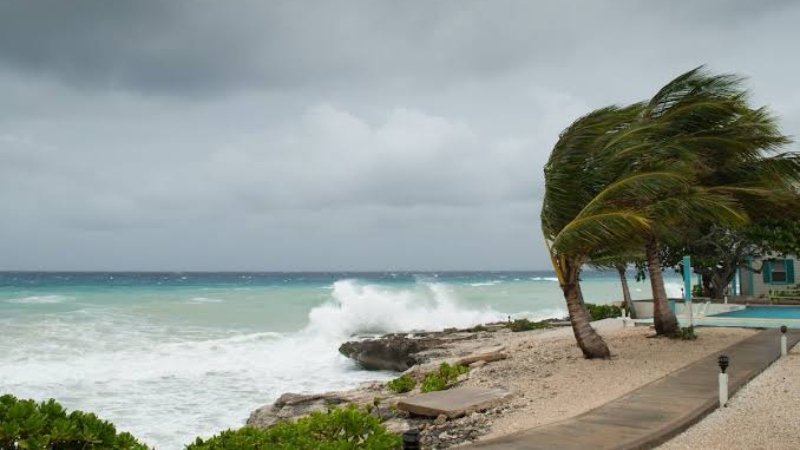
Hurricane Season Covers Half the Caribbean Calendar. Here Is How to Book Around It.
Somewhere around February, the same question starts circulating in travel forums: is it safe to go to the Caribbean during hurricane season? It is the wrong question, and it produces useless answers. The Atlantic season runs June 1 through November 30. Six months out of twelve. Rule all of it out and you have ruled out half the year, most of the good pricing, and a fair amount of genuinely excellent weather.
The useful question is narrower. Which weeks, in which part of the Caribbean, and what happens to your money if a storm turns up anyway.
The risk is not spread evenly across the season
NOAA puts the Atlantic season at June 1 to November 30, but the activity inside those dates is badly lopsided. The climatological peak is September 10, and most of the season’s activity falls between mid-August and mid-October. June, early July and the back end of November are comparatively quiet. Those are averages measured over decades, and any single year can break them. They still matter, because they mean the first week of June and the first week of September are nowhere near the same booking.
The vocabulary is worth getting straight too, since headlines blur it. A tropical cyclone becomes a named tropical storm once sustained winds reach 39 mph, and a hurricane at 74. Most named storms never make it that far, and the ones that do rarely come near any particular island. A named storm somewhere in the Atlantic is not, by itself, a reason to cancel anything.
“Outside the hurricane belt” does more work in marketing copy than in the record
Aruba, Bonaire and Curaçao get sold hard on that line, and the sources do not agree with each other. Aruba’s tourism board states plainly that the island sits outside the hurricane belt. The Meteorological Department Curaçao, which runs the hurricane warning service for those islands, says the opposite in as many words: the ABC islands are on the southern fringes of the belt, and are not outside it, as many consider.
Both are on the record. The disagreement is more useful to you than a tidy answer would be, because the practical reading lands in the same place either way. The southern Caribbean has a far thinner direct-hit history than the Leeward Islands, and far thinner is not none. The same Curaçao met service notes that roughly once a century, cyclones passing over or just south of those islands do considerable damage.
Geography also flips the calendar late in the season. The eastern and southern Caribbean settle down after September. The western Caribbean, meaning Cozumel, Belize and Grand Cayman, carries real risk into October and November. A late-October week in Punta Cana and a late-October week in Cozumel are two different bets, and no booking site is going to tell you that.
The cheapest weeks are cheap for a reason, and the reason is the whole point
Caribbean peak season runs roughly mid-December through April. Hurricane season is the off-peak, and the discount is substantial: flight and resort pricing through September and October is widely reported at 30 to 50 percent below peak, with the Dominican Republic and Jamaica among the steepest drops.
You are being paid to carry risk. That is a defensible trade for two people with flexible jobs, a short flight and nothing riding on the exact dates. It is a much worse trade for nine people flying out of four cities on school calendars and rationed leave, because the cost of a disruption there is not only money. It is the leave they cannot get back.
Here is where it usually goes sideways in practice. Someone picks the safest island on the map to protect the trip, and then the group balks at the number, because the safest weeks and the safest islands are the ones charging peak rates. Anyone who plans group travel for a living watches that collision over and over. Storm risk and group affordability pull in opposite directions, and no month on the calendar optimizes both. You are choosing which one to protect, whether or not you notice you are choosing.
The insurance detail that catches almost everyone
Travel insurance treats a named storm as a known event. Once the National Hurricane Center names it, a policy bought after that point will not cover claims tied to that storm. Insurers publish this openly, and some go further: Travelex maintains a public list of storms showing the date each one became foreseeable, so you can check it against the day you bought.
So the date governing your coverage is not your travel date, and it is not your final payment date. It is the day the policy was issued. The advice insurers give themselves is to buy when you make your first trip payment, which for most resort bookings means the deposit, months before anything is actually at stake.
It is also worth reading what the property already promises, and what it does not. Sandals’ published terms, to take one example, reserve the right to suspend, limit or restrict access to areas, amenities, facilities and activities due to inclement weather. That is an ordinary clause across the industry. It is also a reminder that a rained-out, half-closed week is rarely a refundable event. Coverage tends to begin at cancellation and interruption, and disappointment is neither of those.
What actually happens when a storm lands on your dates
Two kinds of trip behave completely differently here, and people book them as though they were the same thing.
A ship moves. Cruise lines reroute around weather as a matter of routine, so the itinerary changes, the ports change, and the vacation still happens. A resort cannot move. If the property takes damage and closes, your reservation has nowhere to be, and you are suddenly competing with everyone else in the same position for whatever inventory is left anywhere in the brand.
The question to ask before you book is not “what happens if there’s a hurricane.” You will get a soothing non-answer. Ask the specific version instead: if this property is closed for my dates, who rebooks me, what are they allowed to move me into, and who covers the difference in airfare. Then ask how long that took the last time it actually happened.
Group size changes the problem completely. Moving one couple is a phone call. Moving twenty-five rooms, each carrying its own deposit, its own flights and its own opinion about what should happen next, is a week of work compressed into about two days, and it starts with getting someone senior enough inside the brand to say yes. That is the practical case for booking a group through one person who holds the whole block. A full-service travel agent in Germantown, Tennessee, or wherever you happen to live, has a standing relationship to lean on and a single list of who is booked where, which is what gets a group moved while individual reservations are still sitting in a queue.
Decide in this order
Most people choose the resort first, the dates second and the risk last, then try to reason backward into feeling comfortable. Reverse it.
Start with the month band, because that decision does more work than any other. Late November through early June is the low-risk stretch. Mid-August through mid-October is the loaded one. June, July and the tail of November sit in between, and that is where most of the value is.
Then pick the region to match the month. Late in the season, favor the eastern and southern Caribbean over the western. Early in the season, the distinction barely registers.
Then choose the property, and only then ask about its storm record: whether it has closed, how recently, and how the brand handled the guests who were already booked. A resort’s answer to that question tells you more about the week you will actually get than any photograph on its website.
None of this removes the risk. Nothing does. But the travelers who come through hurricane season intact usually share three habits. They knew what they were trading. They bought the policy on the day of the deposit. And they knew, before they left home, exactly who was going to pick up the phone.