Anyone planning a trip to the Khumbu hits the same fork in the road pretty early. One path goes to Everest Base Camp and back, a route thousands of people walk every season. The other loops over three high passes and asks for a lot more time, stamina and patience. Both start in the same mountains. Both can be unforgettable. They are just very different commitments.
Everest Base Camp trekking is the classic. You follow the Dudh Koshi valley upward, climb to Namche Bazaar, and end up standing near the Khumbu Glacier with the biggest peaks in the world around you. The 3 Pass Trek Nepal is the tougher cousin. It ties together Kongma La, Cho La and Renjo La, and it links Base Camp, the Gokyo Lakes and some quieter valleys into one long circuit. This guide compares the two so you can pick the one that matches your time, fitness and appetite for rough ground.
How the two treks really differ
Everest Base Camp trekking: the classic line
The standard route starts with a flight into Lukla, then runs through Phakding, Namche Bazaar, Tengboche, Dingboche, Lobuche and Gorak Shep. From Gorak Shep you walk to Base Camp itself. Many people also climb Kala Patthar, a viewpoint that gives a much better look at Everest than Base Camp does, since the mountain is hidden behind other ridges down there.
The key feature of this trek is its pace. The trail gains height gradually, and rest days are built in so your body gets a chance to catch up. Skip those and the whole thing gets a lot harder.
The 3 Pass Trek Nepal: the long loop
The three passes are Kongma La at roughly 5,535 m, Cho La at roughly 5,368 m and Renjo La at roughly 5,360 m. Cross all three and you move between valleys that the standard Base Camp route never touches. Along the way you can include Everest Base Camp, Gokyo and its lakes, and some high, remote stretches where it feels like you have the mountains to yourself.
Itineraries vary, so don’t treat any single schedule as the only way. What stays the same is the character: longer days, steep climbs, rocky trails, and sections that may be covered in snow or ice depending on the year.
Picturing the routes before you commit
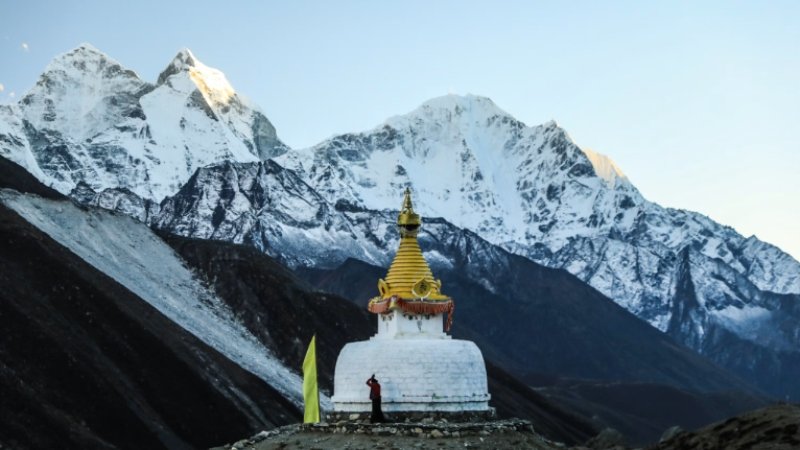
On the Base Camp route, the scenery changes in stages. You begin in forested valleys with rhododendron and pine, cross long suspension bridges, and slowly leave the trees behind. Above Tengboche the land opens up into alpine terrain, then into moraine and glacier country near Lobuche and Gorak Shep.
The three-pass circuit adds the in-between parts. You leave the main trail, drop into side valleys, and climb over the ridges that separate them. Gokyo sits in its own valley west of the main Everest trail, and the passes are what connect it back to the Base Camp side. How you order the circuit, east to west or the other way round, changes how the days feel, which is something to talk over with a guide.
One thing trips people up. Adding the passes is not like adding a few easy days to the end of a Base Camp trip. Snow, wind, altitude and long walking hours can turn a single pass day into the hardest day of the entire journey.
How many days should you allow?
For Everest Base Camp trekking, plan on around 12 to 14 days from Lukla and back. That covers the walking plus acclimatization. If you want extra rest or a safety cushion, it will stretch a bit.
The 3 Pass Trek Nepal usually needs about 18 to 21 days, depending on where you start, which direction you go and how many side trips you add. Those numbers don’t include the time you spend in Kathmandu before and after, so add at least a couple of days for that.
Whichever you choose, leave some buffer. Flights to and from Lukla, whether they leave from Kathmandu or from Ramechhap, get delayed or cancelled by weather fairly often. A tight schedule with no spare day is asking for stress.
Altitude is the part you can’t negotiate with
Acclimatizing on the Base Camp route
Most good itineraries include rest time in Namche Bazaar and Dingboche. The idea is simple: go up slowly, sleep lower than your highest point of the day when you can, and give your body time before climbing further. It feels slow while you’re doing it. It pays off higher up.
Why the passes ask for more care
The three passes all sit above 5,300 m, where there’s far less oxygen in every breath. Even an easy slope can leave you gasping up there. Pushing the pace, or cutting out rest days to save time, is how people end up in trouble.
Learn the warning signs of altitude sickness before you leave. A bad headache with vomiting, confusion, trouble walking in a straight line, or breathlessness while resting all need immediate attention, and the answer is to go down and get medical help. Being fit won’t protect you, because altitude affects strong people just as often as it affects beginners. It’s smart to speak with a doctor who knows high-altitude travel before you go.
Picking your season
Spring, roughly March to May, and autumn, roughly September to November, are the busiest windows. Spring brings flowering valleys and shifting mountain weather. Autumn often has clearer skies, though it can still turn cold fast and forecasts change. Conditions differ from one year to the next, so nothing here is a promise.
Winter can be bitterly cold, and snow on the high passes makes crossings far more serious. The monsoon brings rain, cloud, slippery trails and more flight disruption. For the three passes especially, conditions matter more than the calendar. A crossing that’s fine in stable weather can become dangerous after fresh snow or in poor visibility, so check with someone local before each pass.
Teahouses, food and cash
Most trekkers sleep in teahouses, simple lodges run by local families. Rooms get more basic the higher you go, heating is often limited to the dining room, and things like hot showers, device charging and Wi-Fi usually cost extra.
Menus are pretty similar from place to place. Dal bhat is the favorite for good reason, and you’ll also see noodles, soups, potatoes and eggs. What’s actually available depends on the village and on what made it up the trail that week.
Bring plenty of cash. Don’t count on ATMs or card payments working in remote spots. On the three-pass route, there can be long stretches between settlements, so food, water and start times need more planning than on the standard trail.
Gear that actually matters
Start with boots that are properly broken in. Blisters on day two will wreck a trip faster than almost anything. Then think in layers: base layers, a warm fleece, a down jacket, waterproof outer layers, gloves, a hat, sunglasses and sunscreen. Add a headlamp, a sleeping bag rated for the cold, and a power bank.
Trekking poles help a lot on steep descents and loose ground, especially around the passes. Carry water bottles and a reliable way to treat water, along with your own medication and a basic first aid kit.
For the passes, you may need extra equipment for snow and ice. Ask a qualified local guide about current conditions before you decide whether traction gear is needed. No packing list replaces good judgment on the trail.
Budget, permits and choosing an operator
Rather than guess at a total, think about what goes into the cost: international flights, entry arrangements for Nepal, flights or road transfers to the mountains, permits, lodging, meals, guide and porter services, travel insurance, gear and a reserve for emergencies. A longer trek like the three-pass circuit adds more days of accommodation and services, so it usually costs more. Prices also move with the season, group size and level of service.
Check current permit rules and fees with official Nepal tourism authorities or a reputable local operator before you leave, as these change. If you’re comparing companies, a local outfit such as Adventure Great Himalaya is one example of an operator worth contacting to see how routes and support are arranged. Whoever you pick, ask exactly what the price covers, including Lukla transfers, meals, guide fees, porter arrangements and emergency support.
Which trek is right for you?
Go for Everest Base Camp trekking if your goal is to reach Base Camp, walk through the well-known Khumbu villages, and follow an established trail without taking on three high crossings.
Look at the three-pass circuit if you already have some trekking experience, can spare the extra time for acclimatization, and feel ready for hard climbs and long days in remote country.
Please don’t choose either one just for the photos or to say you did the hardest option. Your health, your past experience at altitude and your willingness to change plans matter far more than ambition.
Final thoughts: choose the trek you can enjoy safely
Everest Base Camp trekking gives you the classic way into the world’s highest mountain. The three-pass circuit is a longer, harder look at the Khumbu as a whole. Pick based on your days, your ability and the trail conditions rather than trying to squeeze the hardest route into a short holiday. In the Himalayas, a flexible plan usually beats an ambitious one. A good booking explains these conditions before departure instead of promising an itinerary that cannot be safely guaranteed.
Questions travelers ask before booking
Difficulty and experience
Is the 3 Pass Trek harder than Everest Base Camp?
Yes. The terrain is tougher, the walking days are longer, and you cross several high passes instead of one steady climb.
Can a beginner do the 3 Pass Trek?
Some newer trekkers are physically able, but it isn’t a great first high-altitude trek. It calls for solid preparation and good support.
Weather and the passes
What if the weather is bad on a pass day?
Sometimes a crossing simply isn’t safe. Follow your guide’s advice, and be ready to wait a day, change the route or turn around.