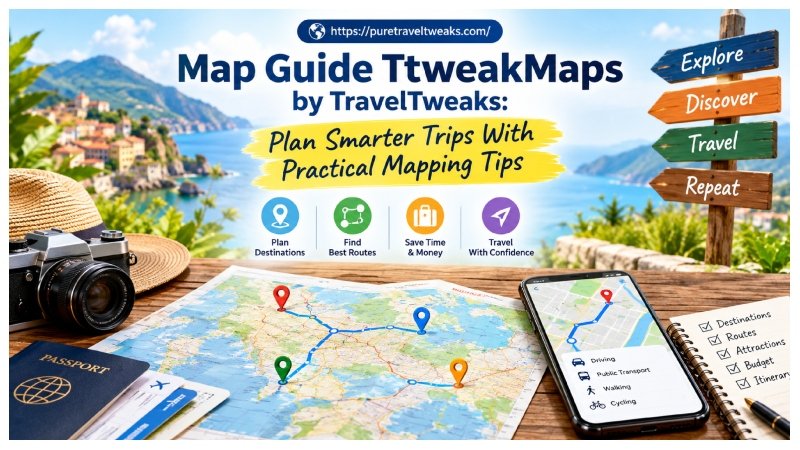
Planning a memorable trip involves more than choosing destinations and booking accommodation. Travelers also need to understand distances, compare transportation options, organize sightseeing stops, and prepare for unexpected changes. Map Guide TtweakMaps by TravelTweaks is a useful topic for anyone exploring how map-based planning can make travel more organized and manageable. With the right approach, a travel map can help you build a realistic itinerary, reduce unnecessary detours, and make better use of your available time.
Whether you are preparing for a weekend getaway, a family holiday, or a multi-city road trip, the goal is to create a plan that balances convenience with flexibility. This guide explains how to organize destinations, evaluate routes, prepare for connectivity problems, and choose mapping tools that suit your travel needs.
What Is Map Guide TtweakMaps by TravelTweaks?
Map Guide TtweakMaps by TravelTweaks relates to the use of maps for travel organization, destination research, and route planning. The central idea is straightforward: understanding the location of places before visiting them can make it easier to organize activities and avoid unnecessary journeys.
Imagine spending three days in a city with museums, historical landmarks, restaurants, parks, and shopping districts. Without a plan, you might travel between distant neighborhoods several times. By placing your preferred destinations on a map, you can identify nearby attractions and arrange them into convenient daily itineraries.
However, the exact capabilities of a specific TtweakMaps product or service should be confirmed through reliable official documentation. Features such as offline navigation, automatic route optimization, live traffic updates, and collaborative map editing should not be assumed without verification.
The practical advice in this guide applies to travel mapping generally and can help readers evaluate whichever mapping resource they choose.
Why Map-Based Travel Planning Matters
A well-planned map helps travelers understand the relationship between destinations instead of treating every attraction as a separate stop. This makes it easier to create an itinerary that works in the real world.
Reduce Unnecessary Travel
One of the simplest ways to improve a travel schedule is to group attractions by location.
For example, if a museum, historic market, and public garden are within the same neighborhood, visiting them on one day may be more convenient than returning to the area several times. This approach can reduce backtracking and leave more time for sightseeing.
Before grouping attractions, check their opening hours, admission requirements, and realistic journey times. Nearby locations do not always have convenient pedestrian access or direct transportation connections.
Make Better Use of Your Budget
Transportation can become a significant part of a travel budget, especially when an itinerary involves multiple neighborhoods or distant attractions.
Mapping your destinations before departure helps you compare walking, public transportation, driving, and other available options. You can also evaluate whether staying near your main activities would reduce daily transportation expenses.
A map does not guarantee lower costs, but it provides useful information for making more informed decisions.
Prepare for Unfamiliar Destinations
Navigating an unfamiliar city can be challenging when street names, public transport systems, and local directions are new to you.
Reviewing a map before arrival helps you recognize important areas, understand the general layout of the destination, and identify the locations of your accommodation and transportation terminals.
This preparation can be particularly helpful when arriving late, traveling with children, or visiting a destination where internet access may be unreliable.
Create a More Flexible Itinerary
Good travel planning should provide direction without making every hour feel compulsory.
A map can help you organize essential activities while identifying alternative attractions nearby. If rain, delays, or unexpected closures disrupt your plans, you can choose another suitable destination without rebuilding the entire itinerary.
How to Use Travel Maps to Plan a Better Trip
The most effective approach begins with your travel priorities and gradually develops into a realistic route. Follow these steps to organize your plans.
Define Your Travel Priorities
Before opening a mapping service, decide what you want from your trip.
Some travelers prioritize historical landmarks, while others prefer outdoor activities, food experiences, shopping, or relaxation. Your interests should determine which destinations deserve space in your itinerary.
Create three simple lists:
- Must-visit places: Attractions that are central to your trip.
- Optional stops: Interesting places to visit if time allows.
- Practical locations: Your accommodation, transport terminals, grocery stores, and other useful services.
This separation prevents your itinerary from becoming overloaded with places you may not realistically have time to visit.
Find and Verify Every Destination
Search for each attraction and confirm that the location matches your intended destination.
Popular attractions, hotels, and restaurants may have similar names. Check the full address and use official websites or booking confirmations when accuracy matters.
Pay particular attention to accommodation addresses, airport terminals, trailheads, and locations outside major cities. A small location error can create a substantial delay.
Group Destinations Into Geographic Areas
Once your destinations are marked or listed, identify which places are reasonably close to one another.
For example, a city itinerary might look like this:
| Day | Main focus | Planning approach |
|---|---|---|
| Day 1 | Historic district | Combine nearby landmarks and museums |
| Day 2 | Parks and waterfront | Allow time for walking and outdoor activities |
| Day 3 | Local markets and shopping | Prioritize places with convenient transport connections |
This is an illustrative itinerary, not a fixed schedule. Adjust it according to your destination, opening hours, reservations, and travel pace.
Grouping places by area can make your schedule more manageable, but always check actual journey times rather than relying on visual proximity alone.
Compare Routes and Transportation
The shortest route is not necessarily the fastest, cheapest, safest, or most convenient.
A walking route may be ideal for a compact city center, while public transportation may work better for longer journeys. Driving can provide flexibility in rural areas but may introduce parking costs, tolls, and traffic delays.
When evaluating a route, consider:
- Estimated journey time and distance
- Public transportation schedules and transfers
- Parking availability and road restrictions
- Walking conditions and accessibility
- Expected costs, including fares and tolls
- Weather and local safety guidance
For important journeys, verify current conditions through appropriate transportation providers or official local sources.
Build a Realistic Daily Schedule
Avoid planning every activity back-to-back. Attractions may take longer than expected, queues can develop, and transportation delays can affect the rest of the day.
Instead, identify one or two main activities and add nearby stops when time permits. Include breaks for meals, rest, and unplanned discoveries.
A flexible schedule is particularly important when traveling with children, older adults, or companions with different interests.
Prepare Your Map Before Departure
If your chosen mapping service supports saved places, custom maps, or downloadable areas, organize the information you need before traveling.
Keep your accommodation, major attractions, transportation terminals, and backup destinations easy to locate. You can also maintain a separate itinerary document containing booking references, opening hours, and reservation details.
Do not assume that every mapping service supports these functions. Check the relevant documentation and test any feature you plan to depend on.
Review Your Plan Before Each Travel Day
Travel information can change. A road may close, a museum may adjust its hours, or a public transportation service may operate on a different schedule.
Spend a few minutes reviewing the next day’s destinations and checking important updates. Confirm reservations and consider alternative routes for time-sensitive activities.
This final review helps turn a general itinerary into a practical plan.
Practical TtweakMaps Planning Tips for Different Types of Travelers
A useful mapping strategy should reflect the kind of trip you are taking. The following examples illustrate how map-based planning can address different needs.
For Road Trips
Road trips require more than identifying the starting point and destination. Drivers may need fuel stations, rest areas, accommodation, food stops, and alternative routes.
Organize stops according to realistic driving distances and allow additional time for traffic, weather, and breaks. Check road conditions and restrictions before entering unfamiliar or remote areas.
Download offline maps if your navigation service supports them, and keep essential directions available in another format. Never rely on a single digital device as your only source of navigation in remote locations.
For Family Vacations
Families often benefit from grouping activities that suit different ages and energy levels.
A morning attraction followed by a nearby lunch stop and a relaxed afternoon activity may be more practical than traveling across a city several times.
When preparing the map, consider accessible entrances, restroom availability, walking distances, and places to rest. Keep the daily plan flexible enough to accommodate changing needs.
For Budget Travelers
Travelers who want to control expenses can use maps to compare accommodation locations, transport connections, and the distance between planned activities.
For example, several free attractions within one area may be easier to combine into a single day than individually visiting distant locations. However, compare total costs rather than assuming that walking or the shortest route is always the cheapest option.
Include transport fares, admission charges, parking, and other relevant expenses in your budget.
For Solo Travelers
Solo travelers may find it useful to organize accommodation details, planned destinations, transport terminals, and return routes in advance.
Research local transport options before arriving, particularly when reaching your destination late at night. Check official safety guidance and share your itinerary with a trusted person when appropriate.
Avoid publicly sharing a map that reveals sensitive information, such as your accommodation address or detailed travel dates.
For International Travelers
International trips can involve language differences, unfamiliar road rules, different transport systems, and inconsistent mobile coverage.
Save important addresses in their local written form when possible. Confirm airport terminals, train stations, transfer points, and accommodation details before departure.
If you intend to drive, research local licensing requirements and road regulations. A navigation app can assist with directions, but it does not replace knowledge of local laws or current travel advisories.
Offline Maps, Live Traffic, and Other Features: What Should You Check?
Travel mapping tools differ in their capabilities. Before relying on a particular feature, check whether it is available for your chosen service, device, and destination.
Offline Map Access
Offline maps can be valuable in remote areas, on long road trips, or when mobile data is expensive.
However, downloading a map does not necessarily provide full navigation functionality. Some services limit offline search, transit information, or other features.
If offline access is essential, download the relevant area before departure and test it while connected to the internet.
Real-Time Traffic Information
Live traffic data can help drivers respond to congestion and delays when their chosen service supports it.
Coverage and accuracy may vary by location. Road closures, weather conditions, and temporary restrictions should be checked through reliable local sources when they could affect an important journey.
Custom Maps and Saved Locations
Some mapping services allow users to save destinations, add labels, create categories, or build customized maps.
These options can help separate hotels from restaurants, attractions, and transport stops. Nevertheless, the available tools and sharing controls vary, so confirm their current functionality before planning around them.
Route Optimization
Some services offer route-planning features, but not every tool automatically calculates the best order for multiple stops.
If automatic optimization is unavailable, you can still arrange destinations manually by considering their locations, opening hours, transport connections, and scheduled activities.
Remember that the mathematically shortest route may not be the most enjoyable or practical option.
Comparing TtweakMaps With Other Travel Mapping Options
If you are evaluating TtweakMaps by TravelTweaks, compare it with established mapping resources according to your actual travel requirements.
| Mapping option | Potential use | What to verify |
|---|---|---|
| Google Maps | Finding destinations and navigating routes | Local coverage, current directions, and offline availability |
| Apple Maps | Navigation and location discovery on supported devices | Regional availability and device compatibility |
| Google My Maps | Creating customized maps with saved locations | Available editing, sharing, and import features |
| Other travel-planning tools | Organizing itineraries and trip information | Supported destinations, pricing, and current capabilities |
| TtweakMaps by TravelTweaks | Evaluate according to the service’s documented purpose | Official availability, features, and limitations |
This comparison is based on general use cases rather than a claim that these tools provide identical functionality.
Before choosing TtweakMaps, confirm that the service is accessible, understand what it actually offers, and determine whether it meets your requirements. A clear explanation of a tool’s limitations is more useful than relying on unverified promotional claims.
Common Travel Mapping Mistakes and How to Avoid Them
Even a detailed itinerary can fail when basic planning issues are overlooked.
Adding Too Many Destinations
An overloaded map may look impressive but leave little time to enjoy each place.
Better approach: Prioritize essential attractions and treat additional stops as optional. Build your itinerary around realistic travel times.
Ignoring Opening Hours and Reservations
A destination may be nearby but unavailable when you arrive.
Better approach: Confirm operating hours, ticket requirements, and reservation times before finalizing the route.
Trusting Estimated Travel Times Too Much
Traffic, road conditions, walking access, and transportation transfers can make a journey longer than expected.
Better approach: Allow reasonable buffers and check current conditions before time-sensitive journeys.
Forgetting the Return Journey
Planning how to reach an attraction is only half the task. Returning to your hotel or catching the last available train may require additional preparation.
Better approach: Check return transportation, operating schedules, and alternative options before leaving.
Depending Entirely on Internet Access
Mobile coverage may be unreliable in remote areas or expensive when traveling internationally.
Better approach: Prepare offline information where available, save important addresses, and keep essential reservations accessible without a continuous connection.
Sharing Maps Without Reviewing Privacy
A shared itinerary may reveal more information than intended.
Better approach: Review permissions and remove sensitive details before sharing a map publicly or with a larger group.
Frequently Asked Questions
What is Map Guide TtweakMaps by TravelTweaks?
It is a travel-planning topic associated with using maps to organize destinations, understand routes, and prepare itineraries. The specific features and availability of the named service should be confirmed through reliable official documentation.
How can TtweakMaps help with travel planning?
A map-based approach can help travelers visualize destinations, organize nearby attractions, compare transportation choices, and prepare a practical schedule. Whether TtweakMaps itself provides specific tools for these tasks depends on its verified capabilities.
Are travel maps useful for planning a road trip?
Yes. Travel maps can help drivers identify destinations, estimate journey times, organize stops, and review alternative routes. Drivers should also check road conditions, local restrictions, and offline navigation options before departure.
Can I use travel maps without an internet connection?
Some mapping services offer offline maps, but functionality varies. Check the service’s current documentation, download the required area in advance if supported, and test offline access before relying on it.
What is the best way to organize destinations on a map?
Start with essential attractions, verify their locations, and group nearby places into daily itineraries. Consider opening hours, travel time, transport connections, and your available budget before finalizing the schedule.
Is TtweakMaps better than Google Maps?
There is not enough verified comparative information here to establish that one is universally better. The right choice depends on your needs, the service’s confirmed features, regional coverage, and ease of use.
How can maps help reduce travel expenses?
Maps can help you compare transportation options, group nearby attractions, and evaluate whether your accommodation is conveniently located. Actual savings depend on local fares, distances, admission costs, and the details of your itinerary.
Conclusion
Map Guide TtweakMaps by TravelTweaks highlights the value of thoughtful map-based travel planning. By organizing destinations, comparing routes, checking essential details, and preparing for unexpected changes, travelers can create itineraries that are more realistic, convenient, and flexible.
The best approach is to begin with your priorities, group attractions by location, and verify important information before departure. Prepare offline resources when available, consider your transportation budget, and leave enough room for rest and spontaneous discoveries.
When evaluating TtweakMaps or any alternative mapping service, base your decision on verified features rather than assumptions. A reliable map should help you make informed decisions, not add unnecessary complexity to your trip. With a practical plan and the flexibility to adapt, you can spend less time managing logistics and more time enjoying the places you visit.